Attraction · Bath · BA2 4AY · Free

Pulteney Bridge, Bath

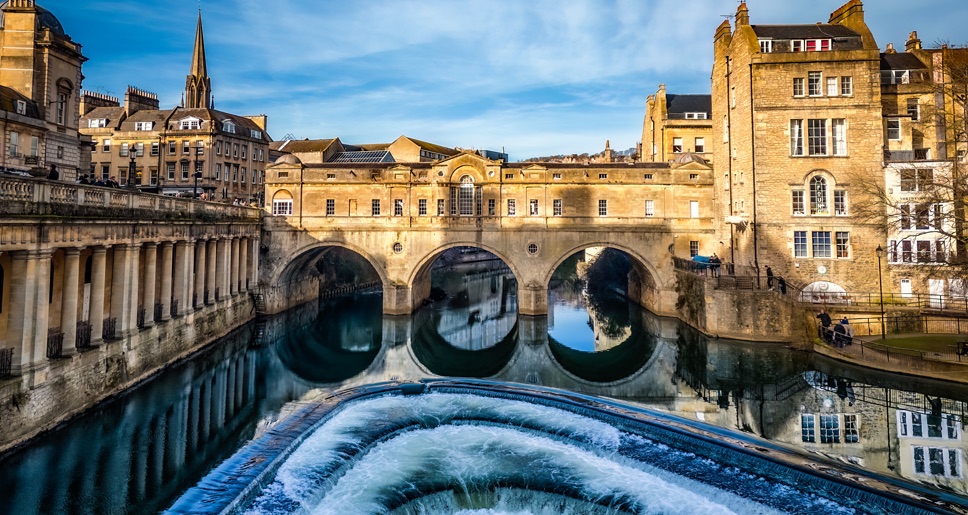
Built 1774, designed by Robert Adam. One of only four bridges in the world with shops built on both sides — the others are in Florence, Venice, and Erfurt. Free to cross. The best view is from the south riverbank with the curved weir below.

Facts and practical information

Built 1774, designed by Robert Adam
Type One of only four bridges in the world with shops on both sides
Crosses River Avon (width at this point: approximately 45 metres)
Weir The Pulteney Weir is immediately downstream — curved horseshoe shape, visible from the bridge and from the riverside path
Address Pulteney Bridge, Bath BA2 4AY
Admission Free — public road
Best view From the south bank of the River Avon, downstream of the bridge — you see the full facade with the weir in front
Nearest parking Manvers Street car park (5 min walk). Use Park & Ride for easier access.

About Pulteney Bridge

Pulteney Bridge was commissioned by William Johnstone Pulteney and completed in 1774, linking Bath's city centre to the Bathwick estate across the River Avon. Robert Adam — who had built his reputation on country house design — gave the bridge a Palladian facade with three arch openings and small Venetian windows on each end. The shops built into both sides were part of the original design, not later additions.

The bridge connects to Argyle Street on the far bank, which leads within a few hundred metres to Laura Place and Great Pulteney Street — the longest Georgian street in Bath and the most filmed Bridgerton location in the city (carriage processions, promenade scenes, Season 1 and 2 street sequences). The walk from the bridge to the far end of Great Pulteney Street is approximately 500 metres.

The Pulteney Weir, immediately downstream, was constructed later to manage river levels and is now integral to the view. Most visitors photograph the bridge from the south bank of the river where you can frame the Palladian facade with the weir in front. The riverside path from Parade Gardens gives you this angle without needing to cross any roads.

Where to photograph Pulteney Bridge

South bank riverbank path — the classic view. Walk from Parade Gardens east along the south bank. You see the full Palladian facade with the weir below. Late afternoon light works best (bridge faces south-west).

On the bridge itself — look over either side to see the river and weir from above. Most visitors miss this — the shops on both sides create a visual corridor that makes you forget you are on a bridge.

From the boat weir level — walk down to the river level via the steps from Parade Gardens. At low river levels you can get very close to the base of the weir.

The Bridgerton walk from Pulteney Bridge

Cross the bridge → Argyle Street → Laura Place → Great Pulteney Street. The 500-metre walk covers the main Bridgerton filming locations for carriage and promenade sequences. Continue to the Holburne Museum at the far end.

Bridgerton self-guided tour →

Walking tours of Bath

Guided tours take in the bridge, the weir, and Great Pulteney Street in context.

Bath tours →

Hotels near Pulteney Bridge

The Bathwick area across the bridge has quieter boutique options.

Hotels nearby →

The Weekend Five

This weekend's top 5 events, in your inbox Friday

Picked from the live feed. One email a week, no filler.

Pulteney Bridge Bath — frequently asked

What is Pulteney Bridge in Bath?
Pulteney Bridge is an 18th-century bridge over the River Avon in Bath, built in 1774 and designed by Robert Adam. It is one of only four bridges in the world with shops built across its full length on both sides — the others are the Ponte Vecchio in Florence, the Rialto in Venice, and Krämerbrücke in Erfurt. The bridge connects the city centre to the Bathwick district and Great Pulteney Street beyond. Access is free.
How do you see the best view of Pulteney Bridge?
The best view of Pulteney Bridge is from the south bank of the River Avon, looking north-west from the riverside path downstream of the bridge. This viewpoint shows the full Palladian facade of the bridge with the curved horseshoe weir in the foreground. The viewpoint is accessible via a short path from Parade Gardens or from the road running along the south bank. Late afternoon light (facing roughly south-west) is best for photography.
Can you walk across Pulteney Bridge?
Yes — Pulteney Bridge is a public road and you can walk across freely. The bridge has shops on both sides as you walk across (cafes, art galleries, gift shops). The crossing takes about two minutes. Once across, you enter Argyle Street, which leads to Laura Place and Great Pulteney Street beyond — the main Bridgerton filming street for carriage and promenade scenes.
Is Pulteney Bridge in Bath used for Bridgerton filming?
Pulteney Bridge appears in Bridgerton establishing shots of Bath. The more prominent Bridgerton location is Great Pulteney Street (the long, wide street that begins beyond the bridge), which was used extensively for carriage processions and promenade scenes in Seasons 1 and 2. The bridge itself and the riverside below it appear in background and transition shots. Crossing the bridge and walking Great Pulteney Street is the most authentic Bridgerton location walk in the city.
What is the weir below Pulteney Bridge?
The Pulteney Weir is a curved horseshoe-shaped weir immediately downstream of Pulteney Bridge on the River Avon. It was constructed to manage the river level and is now one of Bath's most photographed landmarks — the combination of the bridge above and the curved weir below is the classic Bath postcard view. Boat hire operates from near the weir (seasonal). The weir is visible from the bridge and from the south bank riverside path.
Are there shops on Pulteney Bridge?
Yes — Pulteney Bridge has small shops running along both sides of the crossing. These include cafes, art galleries, jewellers, and gift shops. You can stop and browse as you cross. The shops are built into the fabric of the bridge structure, which is what makes the bridge architecturally unusual — most visitors do not realise they are walking across a bridge until they look over the edge at the river below.

Advertisement