c.10,000 BC – 43 AD
Hot springs at Aquae Sulis
Pre-Roman The thermal springs at what is now Bath produced water at 46°C year-round. Celtic tribes of the area regarded the spring as sacred to the goddess Sulis and built a shrine there. The site had ritual significance long before the Romans arrived.
43 AD – c.410 AD
Aquae Sulis — baths, temple, and lead curse tablets
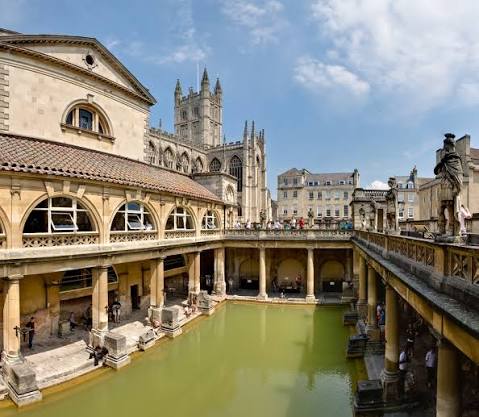
Roman The Romans built a substantial complex of baths and a temple to Sulis Minerva (combining the local Celtic goddess with the Roman Minerva) around the hot springs. Aquae Sulis was a significant urban settlement — not a major military town but an important religious and bathing centre. The Great Bath was lined with lead sheets. Over 130 curse tablets — lead sheets inscribed with requests to the goddess — have been recovered from the sacred spring. The Gorgon's head pediment from the temple is one of the finest pieces of Romano-British sculpture known.
c.577 – 973 AD
King Ine and coronation at Bath Abbey
Anglo-Saxon and Medieval Bath was the site of the first English coronation — Edgar, the first King of all England, was crowned in Bath in 973 AD. By this period, Bath Abbey had been established as a religious house. The hot springs were known and used but not on the Roman scale. Bath remained a significant religious and administrative centre through the Norman period.
1499 – 1616
Bath Abbey rebuilt; spa city emerging
Tudor The current Bath Abbey was begun in 1499 under Bishop Oliver King, who had a vision of angels ascending and descending a ladder from heaven — depicted on the west facade. The abbey was not completed until the early 17th century. The hot springs began attracting visitors seeking cures, and Bath began developing a reputation as a place of healing.
1660 – 1720
Royal patronage and spa culture begin
Restoration and early Georgian Charles II visited Bath in 1663, followed by other royalty. This royal endorsement transformed Bath from a provincial town to a fashionable destination. The concept of 'taking the waters' for health became fashionable and Bath grew rapidly in popularity amongst the upper classes.
1720 – 1800
Ralph Allen, John Wood, and the building of Georgian Bath
Georgian golden age The Georgian period transformed Bath from a medieval city into the planned Georgian city we see today. Ralph Allen (the Bath stone merchant who financed much of the building) and the architects John Wood the Elder and his son John Wood the Younger created the signature streets and crescents. The Circus (John Wood the Elder, 1754) and the Royal Crescent (John Wood the Younger, 1774) are the defining achievements. Richard 'Beau' Nash served as Master of Ceremonies, setting the social rules of the Assembly Rooms. Jane Austen visited and lived in Bath during this period (1801–1806). The Pump Room, where visitors drank the mineral waters, became the social centre of England's most fashionable city.
1800 – 1850
Fashion moves to the seaside; railway arrives 1841
Decline and railway The arrival of the Great Western Railway in 1841 changed Bath permanently. Before, Bath was a destination for the wealthy. After, it became accessible to the middle classes — though Bath's popularity had already waned as the seaside (Brighton, etc.) became the fashionable alternative. Bath's significance as a living city diminished, but this same decline preserved the Georgian architecture: there was less money and less impetus to demolish and rebuild.
1940
Baedeker Blitz 1942 — significant bomb damage
Second World War The Baedeker Blitz of April 1942 — retaliatory German bombing of culturally significant British cities — targeted Bath. Two nights of bombing in April 1942 killed over 400 people and destroyed or damaged approximately 1,900 buildings, including a significant number of Georgian terraces. Some bomb-damaged areas were not rebuilt to the Georgian character — a legacy still visible in some parts of the city.
1987 – present
UNESCO designation and Bridgerton
World Heritage Site Bath was designated a UNESCO World Heritage Site in 1987, recognising the significance of its Georgian planned town, Roman remains, and landscape setting. The arrival of Bridgerton (filming began 2019, Season 1 released 2020) brought a new wave of international tourism focused on the filming locations, particularly Great Pulteney Street, The Circus, and the Assembly Rooms area.