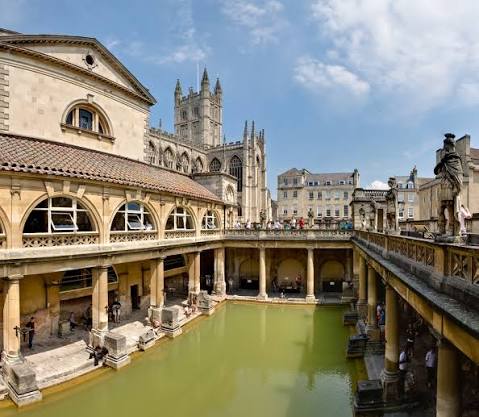
Bath is famous for Roman baths built in the 1st century AD, Georgian streets planned in the 18th century, and the only natural hot springs in Britain open to visitors. It is also one of two UNESCO World Heritage cities in England, a Jane Austen setting, and a filming location for Bridgerton.
In short: Bath is famous for three things above all others — the Roman Baths (Aquae Sulis, 1st century AD, adult £22), Georgian architecture (Royal Crescent, The Circus, Pulteney Bridge — all built 1720–1800), and natural thermal springs (the only ones in Britain, at 46°C, open at Thermae Bath Spa). It has been a UNESCO World Heritage Site since 1987.
Built in the 1st century AD around a natural thermal spring that produces water at 46°C, the Roman Baths (Aquae Sulis) are one of the best-preserved Roman monuments in Britain. The Great Bath, the sacred spring, and over 130 recovered curse tablets are among the highlights. Adult entry from £22. Book online at romanbaths.co.uk.
The Royal Crescent (1774), The Circus (1768), Pulteney Bridge (1774), and Great Pulteney Street are the defining works of 18th-century British urban planning. Bath's Georgian city was built almost entirely between 1720 and 1800 and is UNESCO-listed. The characteristic honey-coloured stone is local Bath stone (oolitic limestone), giving the city its unified visual identity.
The only natural hot springs in Britain open to the public. The rooftop pool at 40°C with views over Bath's rooftops is one of the most distinctive visitor experiences in England. The modern spa building sits alongside the 18th-century Cross Bath (also part of Thermae). Entry from £40 for 2 hours — book in advance at thermaebathspa.com.
Jane Austen lived in Bath from 1801 to 1806, at addresses including 4 Sydney Place (opposite Sydney Gardens) and Gay Street. Bath features prominently in Northanger Abbey and Persuasion. The Jane Austen Centre on Gay Street covers this period of her life. Austen had a complicated relationship with the city — but Bath's association with her is one of its most enduring.
Netflix's Bridgerton (2020–present) uses Bath extensively as a stand-in for Regency London. Key locations: Holburne Museum exterior (Lady Danbury's house), Great Pulteney Street, The Circus, Royal Crescent, Sydney Gardens, and the Assembly Rooms. Bath's intact Georgian streetscape requires minimal set dressing. Season 4 filming continued in Bath in 2025–2026.
Bath was inscribed as a UNESCO World Heritage Site in 1987 — one of only two UK cities with this status (the other being Edinburgh). The designation covers the Roman remains, the medieval Abbey, the Georgian planned town, and the landscape setting. The inscription recognised Bath as an outstanding example of a planned urban environment.
The current Bath Abbey was begun in 1499 under Bishop Oliver King. The fan-vaulted ceiling is one of the finest in England, and the west facade depicts angels ascending and descending a ladder from heaven (the bishop's founding vision). Entry is by suggested donation. Tower tours (£10) give a rooftop view over the city. The Abbey sits in the centre of the city, opposite the Roman Baths entrance.
Bath's distinctive honey-coloured building stone is oolitic limestone quarried from the local hills (Combe Down, Box Hill). It gives the city its unified character — new buildings built to planning requirements use the same stone, so 21st-century buildings sit alongside 18th-century ones without obvious visual disruption. The stone was promoted by Ralph Allen, the merchant who financed much of Georgian Bath.
Plan your visit to Bath
One day in Bath covers the Roman Baths, Abbey, Pulteney Bridge, The Circus, and Royal Crescent. Two days adds Thermae Bath Spa, Prior Park, and a neighbourhood walk. Book hotels early for summer and Christmas Market weekends.
Picked from the live feed. One email a week, no filler.
Frequently asked about Bath
What is Bath most famous for?
Bath is most famous for three things: the Roman Baths (1st century AD, one of Britain's best Roman monuments), its Georgian architecture (Royal Crescent, The Circus, and Pulteney Bridge, all built 1720–1800), and its natural thermal springs (the only hot springs in Britain open to visitors, at Thermae Bath Spa). Bath is also known as a key filming location for Bridgerton (Netflix) and for its association with Jane Austen, who lived here 1801–1806.
Why is Bath a famous city?
Bath's fame rests on its unusual combination of Roman, medieval, and Georgian heritage in a compact, well-preserved city. It has more Grade I listed buildings per square metre than anywhere in England outside London. The thermal springs that made the Roman city significant are still flowing and open to visitors at Thermae Bath Spa. Bath was also the most fashionable city in Georgian England — the setting for Austen's novels — and remains one of the most complete examples of Georgian urban planning anywhere in the world. UNESCO listed it as a World Heritage Site in 1987.
Is Bath worth visiting?
Bath is consistently rated one of the best cities to visit in the UK. A single day covers the headline attractions (Roman Baths, Bath Abbey, The Circus, Royal Crescent, Pulteney Bridge). Two days allows you to add Thermae Bath Spa properly, Prior Park Landscape Garden, and a neighbourhood walk. Most of the Georgian city — the streets, crescents, and parks — is free to walk. The Roman Baths (£22 adult) and Thermae Spa (from £40) are the only significant paid admissions for the main sights.
What food is Bath famous for?
The Sally Lunn bun is Bath's most famous food — a large, soft bread roll sold since the 17th century at Sally Lunn's on North Parade Passage, the oldest house in Bath (c.1482). Bath Oliver biscuits (a plain, dry biscuit traditionally eaten with cheese) were invented by Dr William Oliver, an 18th-century Bath physician. Bath also has a strong independent café and restaurant scene, with the Walcot Street Saturday market, Green Park Farmers' Market, and Guildhall Market all running weekly.
What is Bath stone?
Bath stone is a type of oolitic limestone — a pale, honey-coloured building stone quarried from the hills around Bath (primarily Combe Down and Box Hill). It weathers to the distinctive warm cream tone that defines the city's appearance. The stone has been quarried and used locally since Roman times but became the city's defining building material during the Georgian building boom (1720–1800). Planning requirements in central Bath still mandate the use of Bath stone for new construction, maintaining the city's visual consistency.
Was Bath in Bridgerton?
Yes. Bath features extensively in Bridgerton (Netflix, 2020–present) as a stand-in for Regency London. The Holburne Museum exterior (at the end of Great Pulteney Street) is used as Lady Danbury's house. Great Pulteney Street, The Circus, the Royal Crescent, Sydney Gardens, and the Assembly Rooms have all featured across multiple seasons. Season 4, released 2025, continued filming in Bath. The city's intact Georgian streetscape requires minimal set dressing to read as early 19th-century London.
Advertisement
Cookies
We use essential cookies to run the site, and optional cookies for analytics and ads. You choose.
Manage
Analytics
Helps us understand how visitors use the site (GA4).